Regional Prairie Profiles: Shortgrass, Mixed, and Tallgrass
Before industrial monoculture transformed the interior continent, North America was anchored by an expansive mosaic of perennial grasslands. Understanding the distinct evolutionary pressures of these three primary bands allows home gardeners to install ecologically accurate wildflower matrixes tailored to their regional rainfall and soil hydrology.
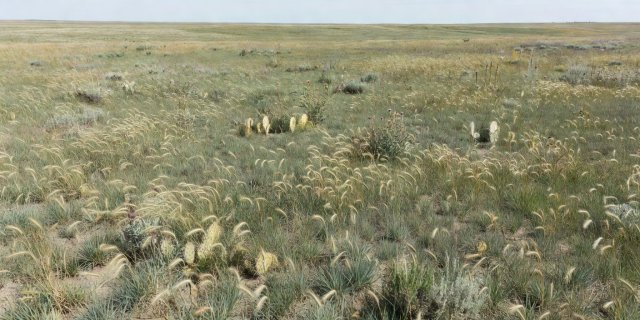
1. Shortgrass Steppe: Low-Stature Arid Tenacity
Forming along the rain shadow of the Rocky Mountains where rainfall rarely surpasses 12 to 18 inches per year, shortgrass ecosystems maximize drought resilience through low foliage height and dense horizontal root crowns. Plant heights typically remain under two feet, making shortgrass ecotypes the ideal choice for municipalities with strict suburban height ordinances.
| Keystone Grass / Forb |
Height Range |
Root Architecture |
Soil Suitability |
| Bouteloua gracilis (Blue Grama) |
8–14 in |
Fibrous dense mat, 4 ft |
Sandy loam, caliche, gravel |
| Bouteloua dactyloides (Buffalograss) |
4–8 in |
Stoloniferous runner net |
Dense clay, alkaline dry soils |
| Dalea purpurea (Purple Prairie Clover) |
12–24 in |
Deep nitrogen-fixing taproot |
Dry gravelly slopes |
| Ratibida columnifera (Mexican Hat) |
12–20 in |
Tough drought-hardy root crown |
Well-drained thin substrates |
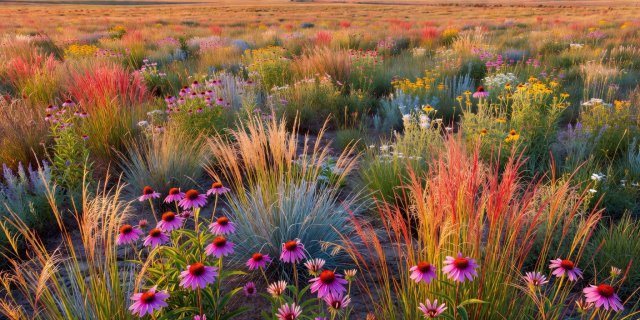
2. The Mixed-Grass Ecocline: Dynamic Botanical Balance
Occupying the central transitional corridor with 18 to 26 inches of rain annually, mixed-grass meadows feature an interwoven tapestry of both low sod-forming grasses and taller bunchgrasses. This zone creates rich seasonal stratification, alternating between early spring emerald blades and bronze late-autumn stems.
In residential gardens, mixed-grass mixtures provide maximum aesthetic balance: they achieve sufficient density to suppress invasive broadleaf weeds while maintaining moderate canopy heights (2 to 4 feet) that resist wind lodging.
| Keystone Species |
Bloom Window |
Ecological Contribution |
| Schizachyrium scoparium (Little Bluestem) |
August – October |
Winter shelter for overwintering queen bumblebees |
| Echinacea angustifolia (Narrow-leaf Coneflower) |
June – July |
Pollen host for specialist Megachilidae bees |
| Bouteloua curtipendula (Sideoats Grama) |
July – September |
Larval host for skippers and ground cover stabilization |
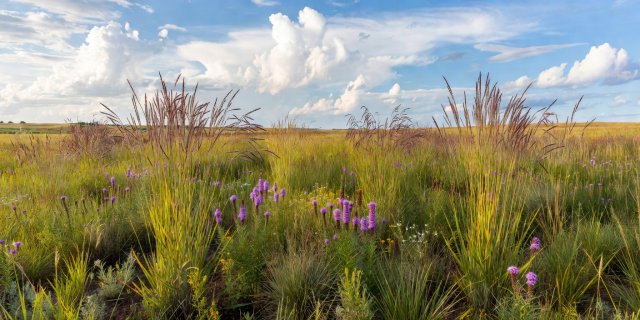
3. Tallgrass Prairie: Giant Carbon-Sequestering Biomass
Flourishing where annual rainfall exceeds 30 inches, the tallgrass biome is renowned for generating the world’s most fertile organic soils (Mollisols). Reaching heights of five to ten feet by late August, tallgrass species like Big Bluestem (Andropogon gerardi) and Cup Plant (Silphium perfoliatum) produce immense lignified stems capable of storing tons of soil organic carbon per acre.
For spacious yards and neighborhood conservation reserves, tallgrass installations create unmatched acoustic privacy buffers and critical habitat for ground-nesting birds.